
10 Best Marine Fenders for Boats in 2026
A safe docking often begins with a quiet detail: the rubber cushion between a hull and a hard quay. The right Marine Fenders can help limit impact damage, but “best” depends on vessel size, berth layout, tidal range, and expected contact energy. No single shape fits every boat.
UNCTAD’s Review of Maritime Transport 2024 reports that global maritime trade grew by 2.4% in 2023, reaching about 12.3 billion tons. That scale highlights why dependable port equipment matters, even though cargo volumes alone cannot tell boat owners which fender to buy. PIANC’s MarCom Working Group 33 guidance centers fender design on absorbing berthing energy while protecting both vessel and berth. A practical takeaway. Match the fender to the conditions, not just its price or appearance.
This guide compares 10 Marine Fenders for boats in 2026, including inflatable, cylindrical, and specialty designs. It considers impact protection, material durability, installation, maintenance, and value. Look for details that matter at the dock: reinforced seams, secure valves, UV-resistant surfaces, and attachment points that suit your rail or cleat. Still, rankings simplify a complicated choice. A highly rated fender may be wrong for a narrow slip or frequent rough-water docking. Use the list as a starting point, then check dimensions and manufacturer guidance against your boat and berth.
Understanding Marine Fenders and Their Role in Boat Protection
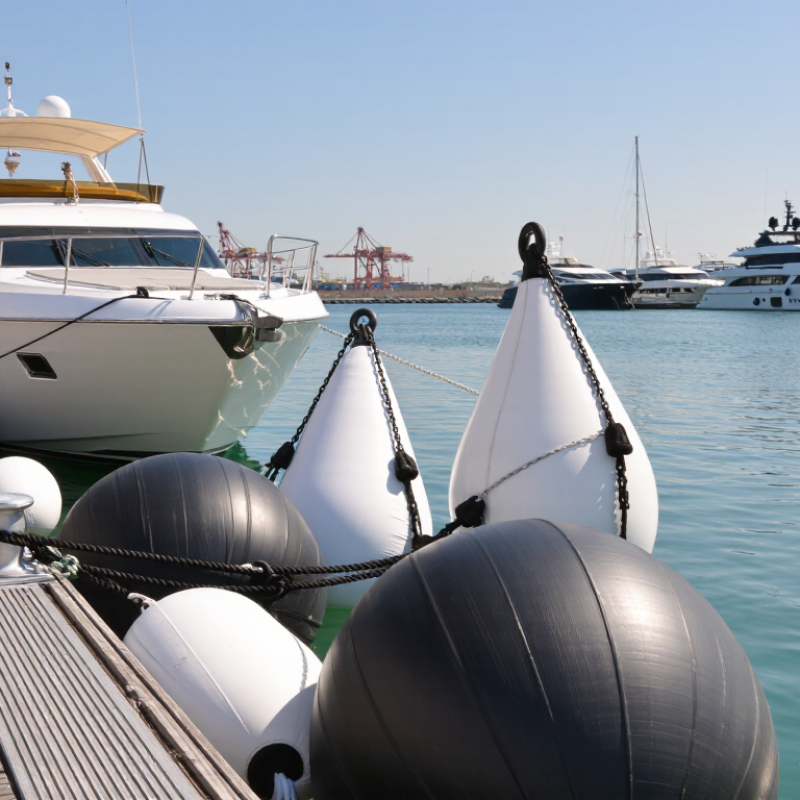
Marine fenders are energy-absorbing cushions between a boat and a dock, piling, or another vessel. They help reduce scratches, pressure marks, and impact loads on the hull. They are not magic, though. A fender that is too small, poorly positioned, or allowed to swing above the contact point may offer little protection. Cylindrical, spherical, and flat fenders suit different hull shapes and berthing conditions. Choose size and quantity with boat length, weight, freeboard, and local exposure in mind.
The U.S. Coast Guard’s 2023 Recreational Boating Statistics recorded 3,844 reported recreational boating accidents. The report does not isolate dock-contact incidents or measure fender performance, so it cannot establish that one style prevents damage better than another. That distinction matters. Practical selection still depends on the boat, berth, and expected movement. A narrow slip with wake exposure may need a different arrangement than a calm, protected dock.
Tips: Place fenders where the hull is widest and likely to meet the dock; check their height after the boat settles. Secure lines so fenders stay in position, then inspect for cracks, leaks, or worn attachment points. I’d check spacing twice; it can feel fussy, but gaps invite hard contact.
10 Best Marine Fenders for Boats in 2026 - Understanding Marine Fenders and Their Role in Boat Protection
| No. | Fender Type | Typical Construction | Common Use | Main Advantage | Selection Consideration |
|---|---|---|---|---|---|
| 1 | Cylindrical fender | Inflatable, elongated body with one or more attachment points | Everyday protection alongside docks and neighboring boats | Easy to position vertically or horizontally | Choose a size and quantity suited to the boat’s length, weight, and docking conditions. |
| 2 | Spherical fender | Round inflatable body, often with a reinforced attachment point | Larger vessels, exposed berths, and situations with changing contact angles | Provides cushioning over a broad contact area | Its size can make storage and handling less convenient on small boats. |
| 3 | Flat fender | Flat or panel-shaped foam or inflatable design | Narrow gaps and areas where a round fender may roll out of position | Broad, low-profile protection against flat surfaces | Check that its shape matches the hull and the surface being protected. |
| 4 | Low-freeboard fender | Compact inflatable or foam body designed to sit close to the waterline | Boats with low hull sides or limited clearance beneath the rail | Can protect areas that taller fenders may not cover well | Position it to protect the hull without allowing it to become trapped under a dock edge. |
| 5 | Pontoon fender | Broad, often flat-sided design made for pontoon rails or fencing | Pontoon boats docking alongside piers or other boats | Covers a wider section of the boat’s side | Check attachment method and coverage against the rail layout. |
| 6 | Corner fender | Angled or shaped body intended to sit around a corner | Boat transoms, dock corners, and other exposed edges | Helps shield areas that standard cylindrical fenders may not cover evenly | Match its shape to the corner and confirm it can be secured in place. |
| 7 | Inflatable rafting fender | Inflatable body designed to sit between boats | Boats tied alongside one another | Creates separation and cushioning between adjacent hulls | Use secure attachment points and check that the fender stays between the hulls. |
| 8 | Foam-filled fender | Closed-cell foam core, usually enclosed in a protective outer layer | Frequent use or settings where maintaining air pressure is inconvenient | Does not rely on inflation to provide cushioning | Consider its weight, bulk, and the condition of its outer covering. |
| 9 | Dock wheel fender | Rotating wheel or roller mounted to a dock edge or piling | Fixed dock corners, pilings, and approach areas | Can guide a hull along a fixed contact point while reducing direct impact | Confirm the mount is suitable for the dock structure and expected contact loads. |
| 10 | Strip or rail fender | Long protective strip attached along a boat rail or dock edge | Repeated contact along a predictable, extended surface | Provides continuous coverage over a longer section | Measure the mounting area and choose a material compatible with the surface. |
Selection note: These are common marine fender styles, not a ranked product list. The right size, number, and placement depend on boat dimensions, hull shape, freeboard, berth conditions, and the manufacturer’s guidance.